Threads of Tradition: At Cluny Embroidery Centre
By Khadeeja Liyana
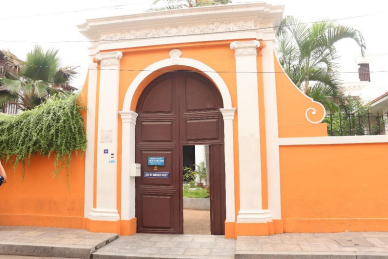
Cluny Embroidery Centre in Pondicherry
Nestled in the heart of Pondicherry, Cluny Embroidery Society revives traditional needlework, empowering artisans and preserving cultural heritage through exquisite craftsmanship and vibrant community spirit. `Nestled in the heart of Pondicherry, Cluny Embroidery Society revives traditional needlework, empowering artisans and preserving cultural heritage through exquisite craftsmanship and vibrant community spirit.
The enormous halls of the 1774 Colonial bungalow, which houses Puducherry’s Cluny Embroidery Centre, are dead silent. The halls feature black and white checkered floors, long hanging fans, and 12-foot doors. Under the 30-foot ceiling, a group of 30 women is bent over needlework. Lilies, hibiscus, birds, and elephants slowly form on the cotton napkins and home linens, with the shapes bending into each other as if they are being painted alive.
With each stitch, heritage is being woven at Cluny Embroidery Centre
Threads of time
The centre is situated in the middle of Puducherry city, on the arterial Roman Rolland Street, but the high walls and obscure wooden gate hide the imposing structure inside, complete with massive white pillars and antique furniture.
The colonial structure, which houses the Cluny Embroidery Society, is known as Hotel Lagrenee de Mézières. It was built in 1774 by Simon Lagrenée de Mézières, a French Councillor in ‘ la Compagnie Francaise des Indes orientales’, the French East India Company. He is now buried at Capuchins Cemetery, on Surcouf Street. It is the oldest French colonial house in Pondicherry.
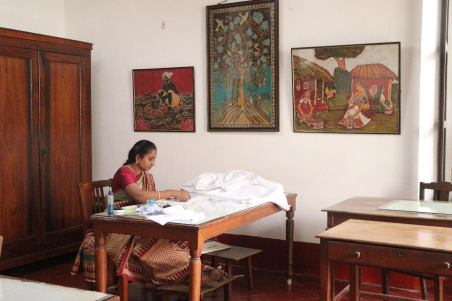
The halls are brimming with antique furniture and framed embroidery
After the councillor’s death, his wife, Madame de Reviere, decided to do something for the homeless widows and donated the mansion to the St. Joseph of Cluny church. This summoned the Cluny nuns to use it to serve the poor, homeless, and destitute widows and orphans. The embroidery section was an idea that emerged 40 years later.
Custodian of Cluny
Sister Irudayam Augusta, a nun in the Church of St. Joseph of Cluny, manages the centre and takes care of the women who are sheltered there. Sister Augusta took over from Sister Teres, a French nun who passed away in 2012. Sister Augusta trained under Sister Teres for three years.

Sister Augusta manages the centre and engages with tourists from all over the world
Sister Augusta discusses the women who work at the centre. She takes great pride in saying that these women earn money through their blood, sweat, and tears, despite the horrible situations and surroundings they come from.
Sister Augusta supervises the centre and interacts with tourists who come from all around the world. She takes the tourists through the process of embroidery and shows the hard work behind every knot. She also informs the tourists about the plight of women who work at the centre.
Tough hand behind the ties and loops
After taking over the Mézières mansion, the church entrusted control to the Cluny nuns for the establishment of an institution aimed at improving the lives of the needy. The first set of nuns arrived from France in 1827 and established a hospital with a creche for abandoned babies, a school, and an old-age home.
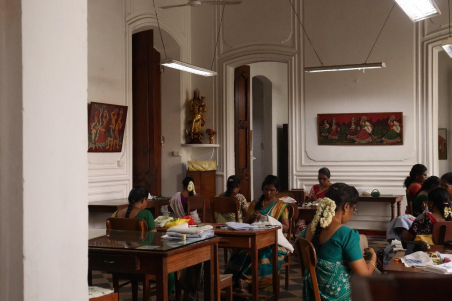
Women weave each knot in dire fixation and reticence
The nuns enrolled the children of the widows in local schools and also decided to teach embroidery to the widows to keep them occupied and to find a livelihood in the process.
The practice continues to this day, with 30 women working at the embroidery centre, including widows, survivors of domestic violence and those who were abandoned by their husbands, now able to support their families and educate children. They work regular hours from 8:00 a.m. to 12:00 p.m. and from 2:00 p.m. to 5:00 p.m. All the earnings from the centre go to these women. They are provided a monthly salary depending on the working hours.
Each of these women comes from a terrible background, and they approach the embroidery centre themselves. Sister Augusta says that many of the women are victims of domestic abuse, and the hard-earned money is even snatched from them by their husbands. Sister Augusta doesn’t wish to disclose the identities of these women. Additionally, these women had to wear glasses due to the long hours, but quitting was not an option for them.
Beauty woven by hand
The perfection in the designs can be attributed to the French nuns who started the centre and passed on the method for two centuries. The distinctive feature of the embroidery is that the front and the back are almost indistinguishable. As there are no knots in the back.
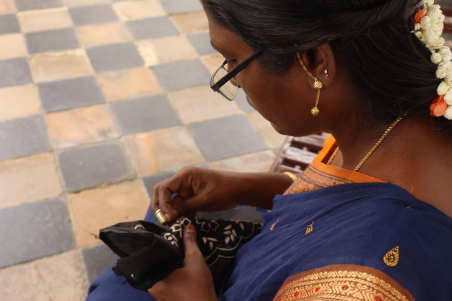
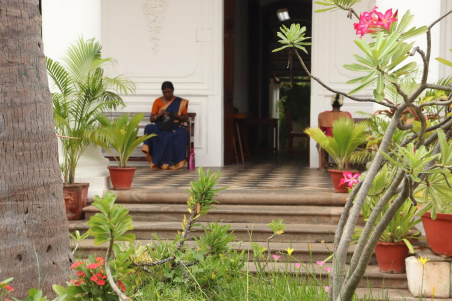
A lady doing embroidery at the façade of the mansion
Workers use photos of real flowers and animals on their phone for reference as they stitch, with some intricate pieces taking up to a week to complete. Sister Augusta says that no prior training or embroidery background is required for new joiners, just abasic aptitude.
The centre sources its cloth from Dindigul, supporting local women. The leader of the group creates designs, and the team embroiders at their own pace. The thread-embroidered pieces comprise napkins, bedspreads, and cloth pieces. The embroidery is complex and multilayered. A single two-inch depiction of a flower has three tonal variations.
Tailoring units and embroidery centres employing the underprivileged are common, but the quality here makes the Cluny embroidery centre stand out, says the clientele. A table napkin or a wall hanging starts at ₹6,000, while a tablecloth and napkin set sells briskly at ₹15000. The cheapest item sold at the centre is a table coaster, which ranges between ₹350 and ₹750.
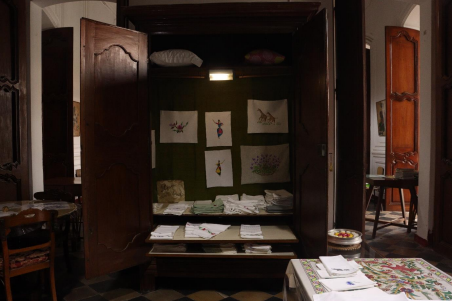
The Embroidery works are neatly displayed in the adjacent room to the working hall.
A Brand Rooted in Heritage and Art.
The prices of the works might seem steep and quite expensive. One might wonder about the number of clients buying these, but the works are sold out even before the work begins, as the Europeans have a weakness for hand-embroidered craftsmanship.
Sister Augusta says that they receive orders from France, NRIs, and various parts of India for specific designs. Tourists often seek them out and purchase the items for a huge price. Even though the number of customers coming from foreign countries is narrowing down, domestic customers are increasing day by day, which helps the Cluny Embroidery centre to keep a roof over the women working there.

Old books on embroidery are displayed in the halls
Vintage maps of Puducherry from when it was a French colony hang on the walls, perhaps the only remnants of the bungalow’s original occupants. Old books on embroidery are kept on a table, which reveals that Cluny Embroidery Centre does keep its roots alive and connected.
Being a local society working to empower women through skill development, Cluny Embroidery Centre helps them in getting sustainable employment opportunities, bringing financial independence and changing living conditions. It preserves the cultural heritage by keeping traditional embroidery techniques alive and passing them on to the generations. The community fosters the community spirit among its artisans and, therefore, encourages a culture of cooperation and personal as well as professional development for all.
In terms of local economy, selling handcrafted productions from Cluny reinforces household economies and encourages sustainable livelihoods. Moreover, Cluny develops the cultural texture through international and local appreciation of traditional craftsmanship, which makes it one of the most important social institutions in Pondicherry.
In every stitch of the thread, there is a story of pain, a story of survival and a story of triumph. Poor, abused and helpless, many women have found hope and a place where they can live to their potential at the Cluny Embroidery Centre established by the Sisters. The art of embroidery has opened doors of freedom for these women.
Curated by: Sayni Khatun & Ankit Raj